 SubsidySeva
ASSAM INDUSTRY DPR GUIDE
Published 26 July 2026 · Last updated 30 July 2026 · Information basis: 29 July 2026
Bamboo Agarbatti Sticks and Finished Incense Manufacturing in Assam
A practical reading of three illustrative DPR models for entrepreneurs choosing between raw bamboo stick production and a more integrated finished-incense business.
Introduction
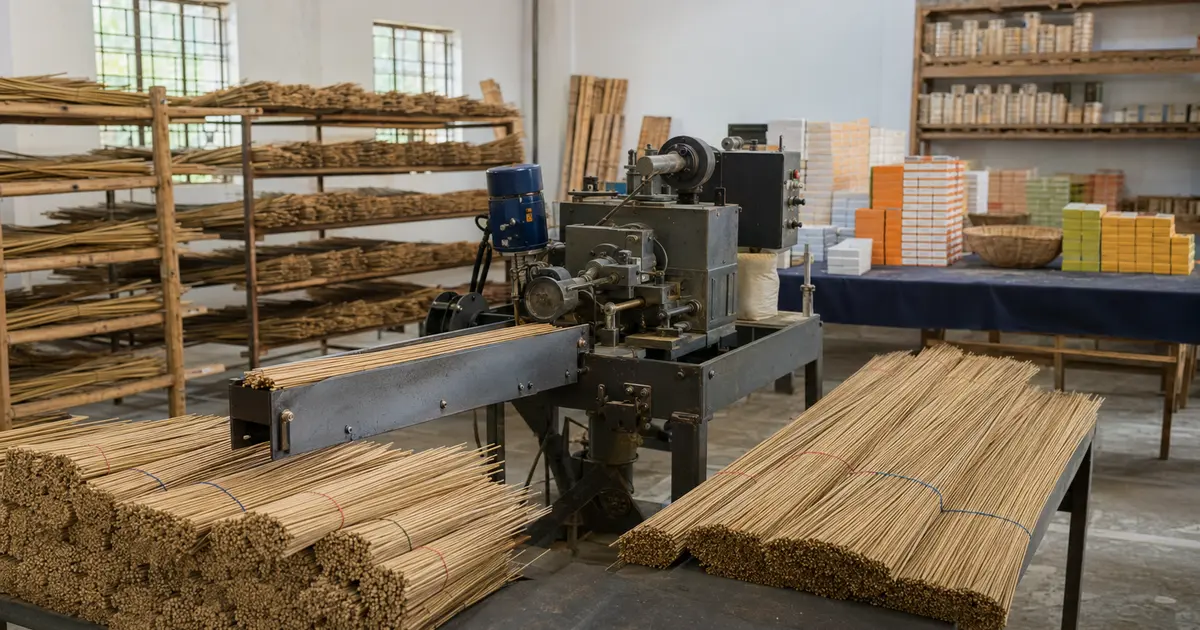
Bamboo agarbatti is not one business but two related ones. A raw-stick unit converts suitable bamboo into straight, dry, consistently sized sticks for sale to incense makers. An integrated unit continues into paste coating, drying, fragrance application and retail or institutional packing. The second route can create more value, but it also adds formulation discipline, fragrance inventory, brand-building, packaging, distributor margins and finished-goods risk.
Assam has an intuitive raw-material story because bamboo is familiar across the region. That advantage is valuable only when supply is organised by species, diameter, maturity, moisture and delivered cost. A plant that purchases irregular culms opportunistically may still lose output through splitting, bending, breakage and inconsistent stick diameter. The commercial question is therefore not simply “Is bamboo available?” It is “Can the unit procure the right bamboo repeatedly, convert it efficiently and sell to customers who pay for consistency?”
Project at a glance
Raw bamboo sticks, total project cost ₹34.19 lakh and year-one sales ₹99.00 lakh.
Raw sticks plus finished incense, total project cost ₹126.21 lakh and year-one sales ₹587.25 lakh.
Larger integrated operation, total project cost ₹328.61 lakh and year-one sales ₹1,360.80 lakh.
Commercial viability
Who should consider this project
- Entrepreneurs who can establish documented bamboo procurement and incoming-quality checks.
- Operators with relationships among incense manufacturers, wholesalers, institutional buyers or regional distributors.
- Teams prepared to measure yield, breakage, moisture, diameter variation, fragrance consumption and batch rejection.
- Promoters who can fund working capital until receivables convert into cash.
- Existing bamboo processors seeking a disciplined downstream product rather than a completely unrelated diversification.
Who should avoid this project
- Promoters relying on an assumed subsidy to bridge an otherwise unviable financing gap.
- Anyone purchasing a full line before validating bamboo grades, recovery and buyer specifications.
- First-time brand owners who have no realistic distributor plan but expect retail packs to sell automatically.
- Units without adequate covered drying, ventilation, fire protection, dust control and safe fragrance handling.
- Projects whose repayment capacity disappears under a modest fall in utilisation or selling price.
Industry overview
Agarbatti demand spans worship, household fragrance, hospitality and gifting. The supply chain includes bamboo growers and traders, stick makers, paste and powder suppliers, fragrance houses, contract manufacturers, regional brands, wholesalers and retailers. Raw sticks compete primarily on straightness, uniformity, moisture, colour, burn behaviour and delivery reliability. Finished products add fragrance quality, smoke profile, pack presentation, brand recognition, channel incentives and repeat purchase.
A sensible entry route is customer-backward. Obtain specifications and trial orders first, then select cutting, splitting, slicing, stick-making, polishing, drying and grading equipment. Integrated production needs separate controls for paste preparation, rolling or coating, drying, perfuming and packing. The equipment list must follow product format and expected batch size; merely copying a vendor quotation into a DPR is not engineering.
Assam and North-East India context
Assam’s Bamboo and Cane Policy recognises bamboo as a livelihood and industrial resource, while the Industrial and Investment Policy of Assam, 2019 lists bamboo activity among thrust manufacturing areas. This policy setting supports serious project examination; it does not create automatic eligibility or compensate for weak procurement and marketing.
North-East location can shorten access to regional bamboo clusters, but collection is fragmented and road movement can be costly. The plant should map seasonal availability, legal transit or sourcing documentation where applicable, aggregation points, species suitability and delivery loss. On the market side, Guwahati and regional towns can support distribution, while bulk raw-stick sales may require relationships outside Assam. Freight must be tested both ways: bulky culms enter the plant, and low-value raw sticks or higher-value packed goods leave it.
Products and likely customers
The low model produces raw bamboo agarbatti sticks. Likely customers are incense manufacturers, job workers and bulk traders. The medium and higher models add finished incense, opening sales to wholesalers, distributors, private-label buyers, temples, hotels and retailers. Each customer group needs a different promise: industrial buyers want dimensional and delivery consistency; consumer channels want fragrance, pack quality, margins and brand recall.
Before committing capacity, define stick length and diameter, packaging quantity, acceptable breakage and moisture, fragrance family, burn time, ash behaviour and target selling price. Samples should be approved in writing. An integrated business should begin with a controlled fragrance range; too many slow-moving variants lock cash in oils, printed packaging and finished inventory.
Raw materials and sourcing
Core inputs include suitable bamboo culms, binding and combustible powders for finished incense, charcoal or other recipe inputs where used, fragrance compounds, solvents or carriers where applicable, packing materials and labels. Procurement specifications should cover bamboo maturity, straightness, node spacing, moisture, pest damage and culm diameter. Receiving records should connect supplier, lot and recovery so poor batches are visible instead of disappearing into an average yield.
Fragrance and chemical inputs need safety data, batch traceability and controlled storage. Packaging should be tested for aroma retention and transport damage. Responsible sourcing is commercially useful: documented supply and less waste improve continuity, while residues may have legitimate secondary uses only after safety, quality and local regulatory checks.
Manufacturing process
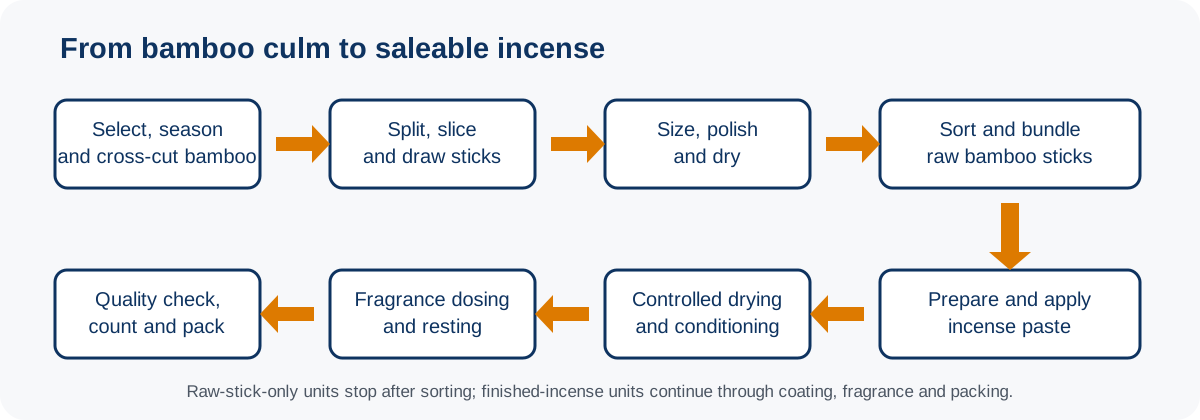
Bamboo is selected, seasoned if needed, cross-cut, split and sliced before the material is drawn or formed into sticks. Sticks are sized, polished, dried and sorted. Integrated production prepares a controlled paste, coats the stick, dries it without distortion, applies fragrance, allows resting or conditioning, then checks, counts and packs the finished product. Quality gates should capture dimensions, moisture, breakage, coating uniformity, fragrance dosage, burn performance and pack count.
Machinery and equipment
A raw-stick line may require cross-cutting, splitting, slicing, stick-making or drawing, polishing, sizing and drying equipment, plus dust extraction, worktables, weighing and inspection tools. Integrated units additionally need mixing, coating or rolling, controlled drying, fragrance handling and packing equipment. Actual selection depends on whether work is manual, semi-automatic or automatic and on the required diameter range.
Get comparable quotations that state output under the project’s bamboo and product specification, connected load, consumables, spares, installation, training, warranty and taxes. Run a material trial where possible. Nameplate speed is not saleable output: recovery, changeovers, operator learning, drying time and quality rejection reduce practical capacity.
Land, building, power, water, and utilities
The layout should separate incoming bamboo, cutting and dust-generating operations, clean drying, fragrance handling, packing, finished goods and rejected material. Covered storage protects both raw material and packaging from humidity. Finished-incense operations need ventilation and controlled access around fragrance or solvent storage. Fire exits, extinguishers, electrical protection and housekeeping must be designed before installation.
Confirm sanctioned power against motor starting loads and simultaneous operation. Water demand may be modest but process and cleaning requirements should be documented. The proposed site must be checked for land-use, factory, pollution-control and fire requirements rather than assuming that a small industrial shed removes these obligations.
Manpower
The illustrative models provide for 5 people in the low model, 24 people in the medium model and 51 people in the higher model. Roles typically include production supervision, bamboo preparation and machine operation, drying and sorting, finishing, packing, quality checks, stores, maintenance, accounts and sales. Job allocation must match actual automation and shift plans.
Training should cover blade and machine safety, lockout practices, dust exposure, ergonomics, fragrance handling, fire response and batch records. Incentives based solely on piece count can damage quality; productivity should be balanced with rejection and rework measures.
Registrations, licences, and approvals
Project-specific verification normally starts with the business constitution, PAN and banking, Udyam registration, local trade permissions and tax registration where applicable. The Pollution Control Board, Assam states that Consent to Establish is obtained before establishment and Consent to Operate follows after pollution-control measures are in place. Factory plan approval, registration and licensing apply where the statutory scope and thresholds are met. Fire safety NOC requirements depend on the premises and activity, with documents and inspection governed by Assam Fire and Emergency Services.
A packer of pre-packed commodities should check registration and labelling obligations with Assam Legal Metrology. Labels, fragrance claims and consumer declarations must be reviewed for the actual pack. Employment, electrical, boiler, storage, waste, forest or transit and local-body requirements may also arise from the chosen site, process and input route. This is a screening list, not a licence opinion; obtain written classifications from the responsible authorities before ordering equipment.
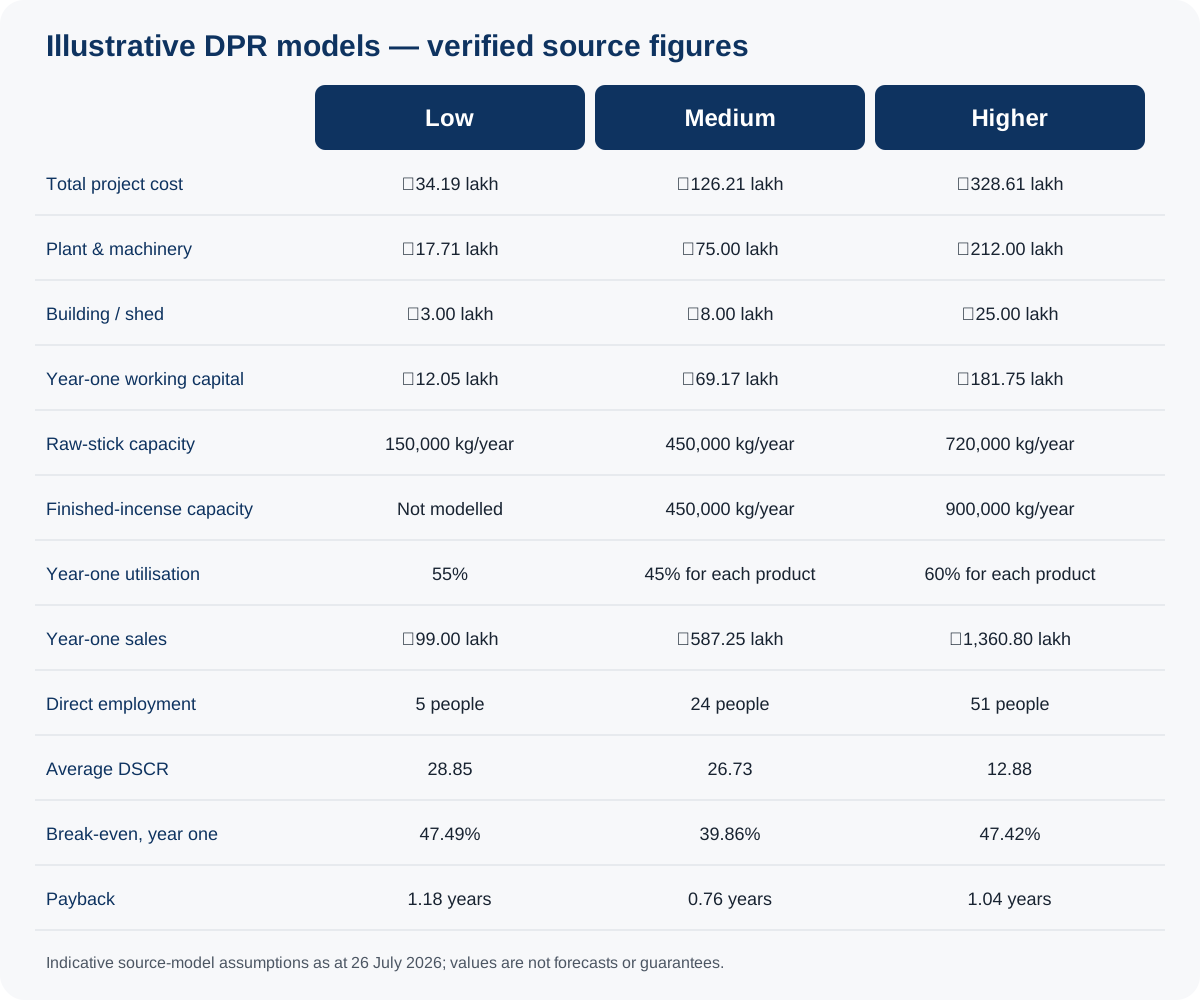
Low, medium, and higher DPR comparison
| Verified source metric | Low | Medium | Higher |
|---|---|---|---|
| Total project cost | ₹34.19 lakh | ₹126.21 lakh | ₹328.61 lakh |
| Plant and machinery | ₹17.71 lakh | ₹75.00 lakh | ₹212.00 lakh |
| Building or shed | ₹3.00 lakh | ₹8.00 lakh | ₹25.00 lakh |
| Year-one working capital requirement | ₹12.05 lakh | ₹69.17 lakh | ₹181.75 lakh |
| Raw bamboo stick installed capacity | 150,000 kg/year | 450,000 kg/year | 720,000 kg/year |
| Finished incense installed capacity | Not modelled | 450,000 kg/year | 900,000 kg/year |
| Year-one capacity utilisation | 55% | 45% for each product | 60% for each product |
| Year-one sales | ₹99.00 lakh | ₹587.25 lakh | ₹1,360.80 lakh |
| Direct employment | 5 people | 24 people | 51 people |
| Average DSCR | 28.85 | 26.73 | 12.88 |
| Break-even level, year one | 47.49% | 39.86% | 47.42% |
| Payback period | 1.18 years | 0.76 years | 1.04 years |
Financial interpretation
The models scale sharply. Plant and machinery rises from ₹17.71 lakh to ₹75.00 lakh and ₹212.00 lakh, while year-one working capital rises from ₹12.05 lakh to ₹69.17 lakh and ₹181.75 lakh. That working-capital curve matters: larger sales do not automatically fund themselves, particularly when distributors seek credit and raw material, fragrance and packaging must be purchased before collection.
The modelled average DSCR figures of 28.85, 26.73 and 12.88, and payback figures of 1.18 years, 0.76 years and 1.04 years, are unusually strong-looking. They should be treated as outputs of illustrative assumptions, not as lending promises. A lender-ready appraisal must rebuild debt, interest, repayment, utilisation, pricing, gross margin, inventory, receivables and tax assumptions around current quotations and a credible sales plan. Stress-test delayed ramp-up, lower recovery, higher bamboo cost, fragrance inflation, customer credit and rejection.
Key risks and sensitivities
- Input variability: unsuitable or wet bamboo reduces straight-stick recovery and raises breakage.
- Sales concentration: dependence on one bulk buyer weakens price and credit control.
- Working capital: distributor credit can consume the apparent operating surplus.
- Brand execution: finished products need fragrance repeatability, compliant packs and channel investment.
- Humidity and drying: uncontrolled conditions affect shape, coating and fragrance stability.
- Safety and compliance: blades, dust, electricity, fire load and fragrance storage require engineered controls.
- Model optimism: fast payback and high DSCR are sensitive to utilisation, selling price and margin.
Implementation roadmap
- Choose raw sticks only or integrated finished incense, and define exact specifications.
- Secure supplier samples, conduct recovery trials and document delivered bamboo cost.
- Obtain buyer feedback, trial orders or letters of commercial interest.
- Shortlist the site and obtain written regulatory scoping for pollution, factory, fire and local approvals.
- Collect comparable machinery, electrical, civil, safety and working-capital quotations.
- Prepare a customised DPR with promoter contribution, financing, sensitivity and implementation schedule.
- Apply through the appropriate bank and official portals; do not assume incentive sanction.
- Install, trial, train and stabilise quality before committing full sales volume.
Potential subsidy and finance routes — preliminary assessment only
Depending on the exact activity, location, constitution and status of the unit, investment size and timing, promoter profile, project cost, financing, employment conditions, applicable negative lists and the notifications in force, this project may potentially be considered under UNNATI 2024, the Industrial and Investment Policy of Assam, 2019 as amended, PMEGP, or another programme. These schemes are not interchangeable, and the same project may not qualify under all three. Eligibility, sanction, approval and disbursement rest solely with the concerned bank or government authority.
UNNATI 2024 Requires project-specific verification
The scheme’s current portal and amended deadline make route review timely, but manufacturing registration depends on notified conditions, eligible fixed capital, location, activity and scrutiny. The low and medium source models show plant and machinery below ₹1 crore; the higher model shows ₹212.00 lakh and therefore crosses that headline threshold, but even it is not automatically eligible. Negative-list treatment, core/non-core assets, commencement timing and registration must be checked on the official portal and against the notification and guidelines.
Industrial and Investment Policy of Assam, 2019 as amended Potentially relevant
The official policy lists bamboo activity among thrust manufacturing areas, and the policy period was extended from 1 September 2024 until further orders. Relevance remains conditional on the actual enterprise, location, new or expansion status, eligible investment, production dates, approvals, amendments and authority verification. Any package calculation must use the current text and admissible assets rather than the project’s total cost alone.
PMEGP Requires project-specific verification
The revised PMEGP guidelines cap a manufacturing project for margin-money subsidy at ₹50 lakh. The low model’s ₹34.19 lakh total project cost is within that headline ceiling; the ₹126.21 lakh medium and ₹328.61 lakh higher models are not. The low model still requires checks on applicant eligibility, new-unit status, own contribution, bank appraisal, permissible activity, project cost composition and non-duplication. Application never guarantees bank sanction or subsidy.
Eligibility, approval and disbursement rest solely with the concerned bank or government authority.
Request a customised DPR on WhatsAppFull illustrative DPR offer
Full illustrative DPR package — ₹1,500 per selected investment model
Select one: Low-investment model, Medium-investment model, or Higher-investment model. The selected private package contains a complete illustrative DPR PDF and editable financial-model Excel. These paid files are supplied privately after selection; this public page does not provide a download link.
The model is illustrative. Actual promoter, location, quotations, capacity, constitution and financing must be incorporated before bank or authority submission. Applicable taxes will be confirmed before payment. Purchasing a DPR does not create or guarantee subsidy eligibility or bank finance.
Customised DPR offer
A customised DPR replaces illustrative inputs with the promoter’s constitution, proposed Assam location, bamboo and consumable quotations, selected machinery, civil and utility needs, buyer plan, financing, repayment and applicable approvals. It should also separate technically achievable output from prudent bank-appraisal utilisation. Supported by a team of experienced Chartered Accountants.
For a customised proposal, use the project-specific WhatsApp review action in the scheme section or email subsidyseva@gmail.com. The WhatsApp number is +91 91810 21225.
Frequently asked questions
Should a first-time entrepreneur start with raw sticks or finished incense?
Raw sticks reduce formulation, fragrance, packaging and consumer-brand complexity, but still demand reliable bulk buyers. Finished incense offers more value capture only when the promoter can manage product development and distribution. Start with the customer route you can actually prove.
Is local bamboo availability enough to make the unit viable?
No. Suitability, maturity, moisture, straightness, delivered price and conversion recovery matter more than general availability. Run procurement and recovery trials before fixing capacity.
Does the ₹34.19 lakh low model qualify under PMEGP?
Its cost is within the current ₹50 lakh manufacturing ceiling, but that is only one condition. Applicant, new-unit status, contribution, activity, bank appraisal and scheme rules still require verification.
Is the higher model automatically eligible for UNNATI 2024?
No. Its ₹212.00 lakh plant and machinery figure crosses a key headline threshold, but activity, location, admissible investment, timing, registration and official scrutiny remain decisive.
Can the illustrative payback and DSCR be used in a bank application?
Not without rebuilding them for current quotations, proposed debt terms, customer credit, realistic utilisation and promoter circumstances. They are source-model assumptions, not certified outcomes.
Do you provide the complete DPR and Excel publicly?
No. This page shows a cross-checked preview only. A selected illustrative PDF and editable Excel are supplied privately; customised bank or authority submission requires project-specific inputs.
Sources and information basis
Financial figures were cross-checked against all six paired source DPR files dated 26 July 2026. Scheme and compliance information was checked through 29 July 2026. Official sources can change; verify the current notification and authority position before relying on a route.
- DPIIT — UNNATI 2024 official portal (accessed 29 July 2026).
- DPIIT — UNNATI 2024 amendment dated 1 April 2026 (official document checked 29 July 2026).
- DPIIT / NSWS — General Operational Guidelines for UNNATI 2024 (official document checked 29 July 2026).
- DPIIT — 19th District Level Committee minutes (official document checked 29 July 2026).
- Government of Assam — Industrial and Investment Policy of Assam, 2019 (official document checked 29 July 2026).
- Government of Assam — IIPA amendment notification, 2023 (official document checked 29 July 2026).
- Government of Assam — extension of IIPA 2019 from 1 September 2024 (official document checked 29 July 2026).
- Ministry of MSME / KVIC — Revised PMEGP Guidelines (official document checked 29 July 2026).
- Government of Assam — Assam Bamboo and Cane Policy, 2019 (official document checked 29 July 2026).
- Pollution Control Board, Assam — Consent/Authorisation Management (accessed 29 July 2026).
- Government of Assam Labour Commissionerate — factory registration and licensing (accessed 29 July 2026).
- Assam Fire and Emergency Services — Fire Safety NOC (accessed 29 July 2026).
- Assam Legal Metrology — registration of manufacturer or packer (accessed 29 July 2026).
- Ministry of MSME — official Udyam registration portal (accessed 29 July 2026).
Independent-consultancy disclaimer
SubsidySeva provides private project and incentive advisory. This guide is general information based on illustrative source models and official material available on the information-basis date. It is not financial, legal, tax, engineering, safety or regulatory certification, and it does not guarantee market performance.