Manufacturing DPR guide · Assam and North-East India
PVC Pipes and Fittings Manufacturing in Assam
PVC pipe manufacturing can suit a freight-sensitive regional market, but the project succeeds only when its product mix, dies and moulds, quality-control system, dealer credit and working-capital funding are designed together. This guide compares three reconciled illustrative DPR models rather than presenting one generic factory.
Published: 2026-07-27 · Last updated and information checked through: 2026-08-02
Plain-language introduction
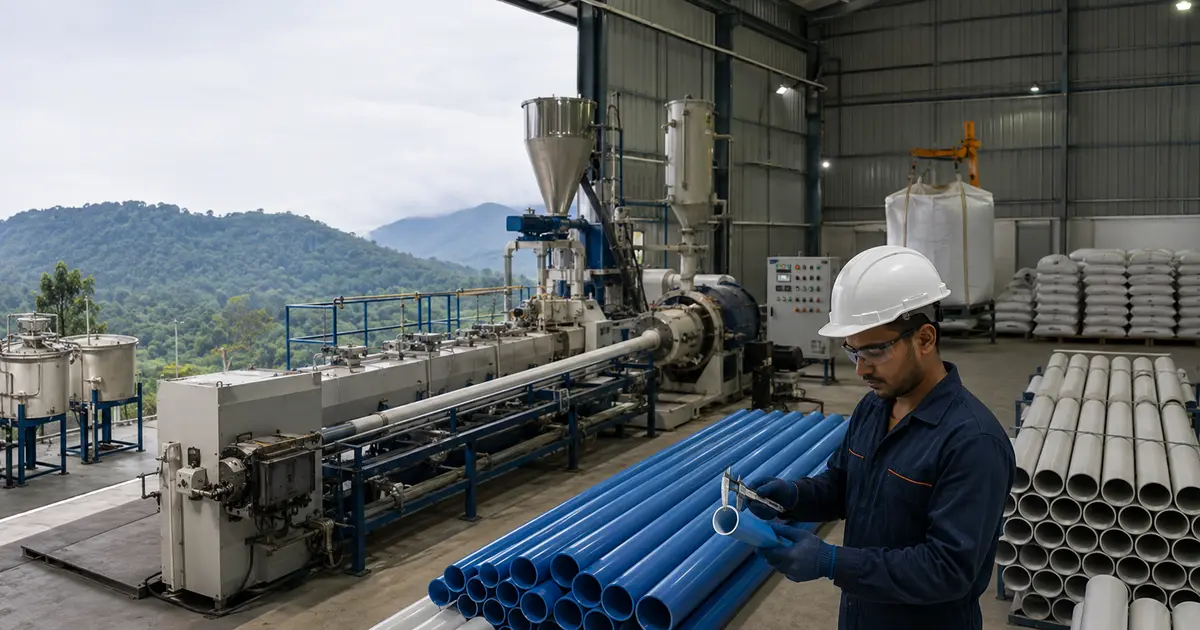
A PVC pipe plant converts resin and carefully controlled additives into rigid pipes through hot-cool mixing, extrusion, calibration, cooling, haul-off and cutting. Some products then need socketing, threading or slotting. A fittings plant adds injection-moulding machines and a substantial mould library. The commercial challenge is not merely buying an extruder: the unit must hold the right sizes, maintain dimensions and pressure performance, manage dealer credit, and keep enough raw material and finished stock without exhausting cash.
Quick project snapshot
Low-investment model
Conduit and small-bore pressure pipe, with ₹115.17 lakh total project cost and 384,000 kg/year pipes installed capacity.
Medium-investment model
A broader agricultural, casing and plumbing range, with ₹534.72 lakh total project cost and 3,300,000 kg/year pipes installed capacity.
Higher-investment model
Multiple pipe categories plus fittings, with ₹1,374.09 lakh total project cost and 6,000,000 kg/year pipes + 1,200,000 kg/year fittings installed capacity.
Straight commercial verdict
Who should consider this project
- Promoters with building-material, irrigation, plumbing or borewell dealer relationships.
- Existing plastics businesses that understand resin purchasing, production control and credit recovery.
- Teams able to appoint an experienced extrusion and quality head before trial production.
- Promoters with adequate equity for stock, receivables and the commissioning ramp-up.
Who should avoid this project
- Promoters relying only on projected subsidy to fund the factory.
- Businesses without technical control over formulation, dimensions and testing.
- Projects that assume every nominal kilogram of installed capacity will sell immediately.
- Units without a realistic plan for dealer credit, slow-moving sizes, returns and freight.
Industry overview
PVC pipes serve water supply, irrigation, plumbing, borewell casing, drainage and electrical-conduit applications. These are not interchangeable products. Each range has its own resin formulation, dies, sockets or threads, pressure class, marking, tests and sales channel. A factory should therefore select a defensible opening range rather than purchasing equipment for every possible diameter.
Assam and North-East India context
Long inbound routes make pipes expensive to transport relative to their value, which creates a local-service advantage for dependable regional suppliers. That advantage is lost if the factory ships inconsistent quality or cannot maintain dealer stock. Assam also offers access to neighbouring North-East markets, but route economics, state-wise dealer credit and monsoon logistics must be tested product by product. Market size is not the same as achievable sales; distributor appointments and realistic catchments should be documented before final financing.
Products and likely customers
The low model focuses on rigid conduit and smaller pressure pipe. The medium model adds agricultural or pressure pipe, threaded casing or screen pipe, and plumbing or conduit products. The higher model combines larger pipe capacity with injection-moulded fittings. Likely customers include pipe and sanitary dealers, irrigation suppliers, borewell contractors, electrical distributors, builders, institutions and infrastructure contractors. Tender sales can provide volume but may lengthen certification, receivable and security cycles.
Raw materials and sourcing
The basic input is PVC resin, supported by stabilisers, processing aids, impact modifiers, fillers, lubricants, pigments and packaging material according to product and standard. Procurement decisions must compare landed Assam cost, batch consistency, credit, minimum order size and freight. Formulation cost cannot be reduced blindly: excess filler or poor additive control can damage strength, surface finish and long-term field performance. Clean internal scrap may be segregated and reused only within validated limits; contaminated or mixed scrap requires controlled disposal or an authorised downstream route.
Manufacturing process
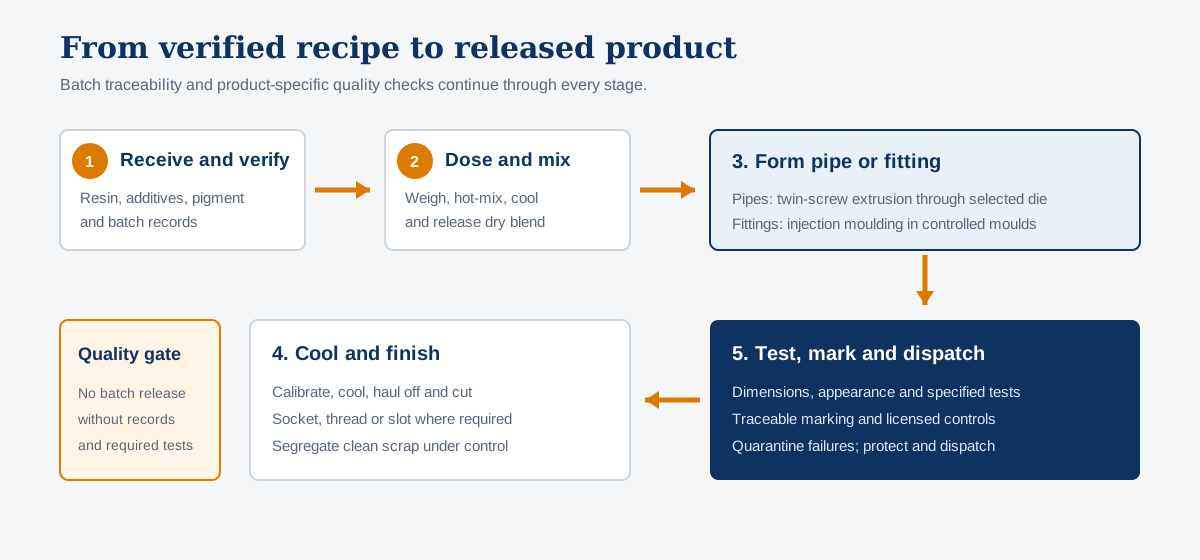
Incoming materials are verified and batch-weighed. Hot mixing disperses additives and the cool mixer stabilises the dry blend. Pipe lines feed the blend to a twin-screw extruder, then shape it through a die, calibrate under vacuum, cool, haul off and cut. Product-specific finishing may include socketing, threading or casing slotting. Fittings use injection moulding with controlled mould temperature and cycle settings. Finished batches are inspected, tested, marked, quarantined on failure and released with traceable records.
Machinery and equipment
A practical pipe line includes material handling, hot-cool mixer, extruder, dies, vacuum calibration tank, cooling tank, haul-off, cutter, printer and socketing or threading equipment as required. Casing products may need slotting. Fittings require injection-moulding machines, dryers or feeders where applicable, moulds, cooling and handling. Laboratory equipment should match the exact standards and product claims. The mould and die budget is often underestimated; size additions should be tied to sales evidence.
Land, building, power, water, and utilities
The layout needs straight line length for extrusion, separate raw-material and finished-goods storage, safe electrical distribution, cooling-water circulation, compressor space, laboratory, rejected-product quarantine and vehicle movement. A reliable industrial power connection and backup plan are essential. Process water is mainly associated with cooling and should be recirculated with proper treatment and temperature control. Lease tenure should comfortably exceed the proposed loan tenor and preserve lender access and renewal protection.
Manpower
The core team normally includes production supervision, skilled extrusion and injection operators, mixer and finishing operators, electricians or fitters, quality staff, helpers, stores, dispatch, accounts and sales. Shift coverage must include relief and maintenance; one expert cannot safely cover every line around the clock. The reconciled models indicate 9 people, 29 people and 58 people respectively in year one.
Registrations, licences, and approvals
Udyam registration is provided through the official Ministry of MSME portal. A unit should obtain site-specific pollution-control consent, factory plan approval or licensing where applicable, fire-safety clearance, power sanction, GST registration and local permissions before operation. Product-standard applicability must be settled for each proposed SKU: BIS manuals identify IS 4985:2021 for covered PVC-U water-supply pipes, IS 9537 Part 3 for covered rigid insulating conduits, IS 12818 for covered screen and casing pipes, and IS 7834 for covered injection-moulded PVC socket fittings. The promoter must verify the current quality-control order, certification and marking position for the exact product before commercial supply.
Low, medium, and higher DPR comparison
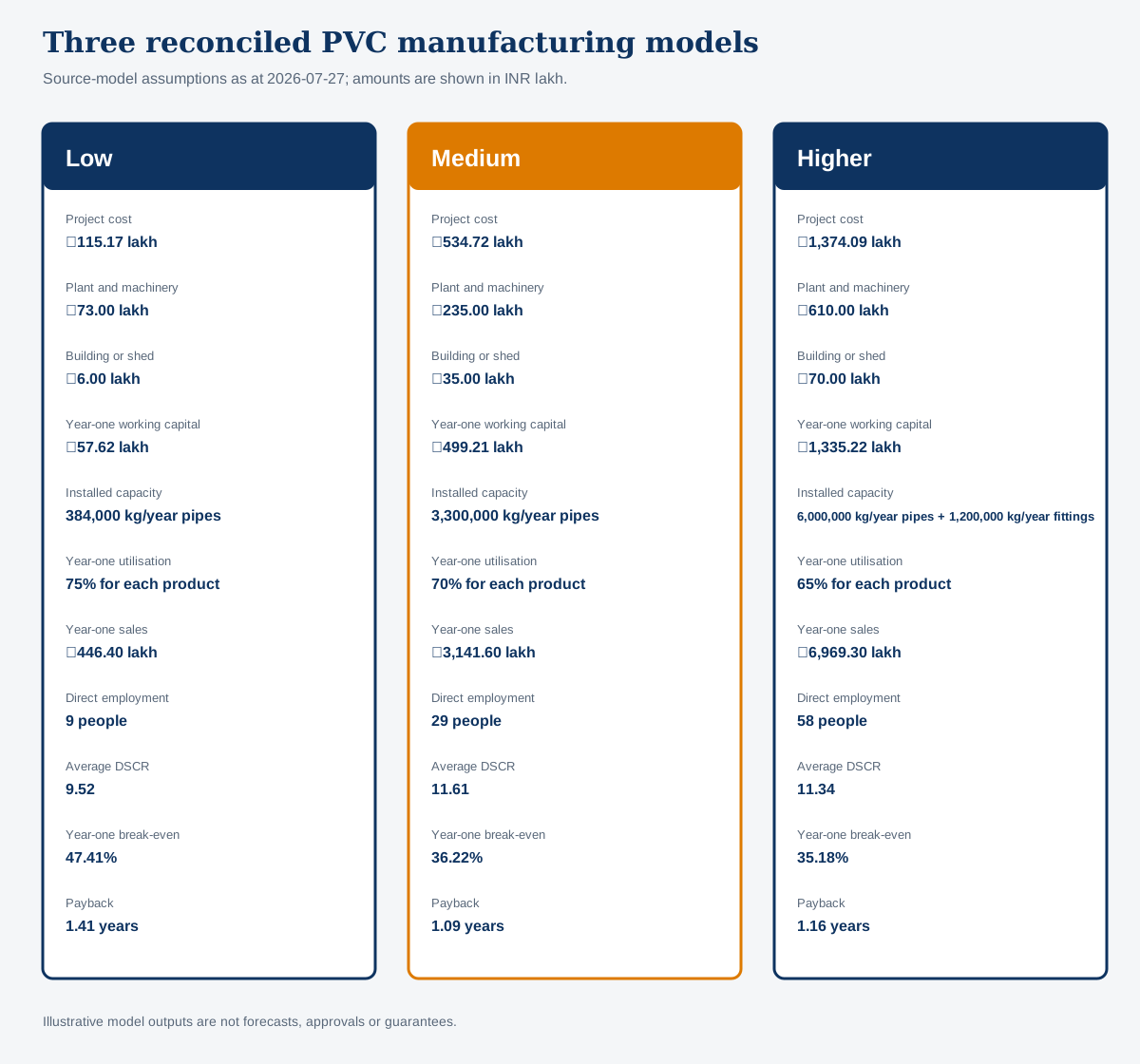
The following figures come from the three matched source workbooks and PDFs. They are displayed without changing the underlying values.
Low model
| Total project cost | ₹115.17 lakh |
|---|---|
| Plant and machinery | ₹73.00 lakh |
| Building or shed | ₹6.00 lakh |
| Year-one working capital requirement | ₹57.62 lakh |
| Installed capacity | 384,000 kg/year pipes |
| Year-one capacity utilisation | 75% for each product |
| Year-one sales | ₹446.40 lakh |
| Direct employment | 9 people |
| Average DSCR | 9.52 |
| Year-one break-even level | 47.41% |
| Payback period | 1.41 years |
Medium model
| Total project cost | ₹534.72 lakh |
|---|---|
| Plant and machinery | ₹235.00 lakh |
| Building or shed | ₹35.00 lakh |
| Year-one working capital requirement | ₹499.21 lakh |
| Installed capacity | 3,300,000 kg/year pipes |
| Year-one capacity utilisation | 70% for each product |
| Year-one sales | ₹3,141.60 lakh |
| Direct employment | 29 people |
| Average DSCR | 11.61 |
| Year-one break-even level | 36.22% |
| Payback period | 1.09 years |
Higher model
| Total project cost | ₹1,374.09 lakh |
|---|---|
| Plant and machinery | ₹610.00 lakh |
| Building or shed | ₹70.00 lakh |
| Year-one working capital requirement | ₹1,335.22 lakh |
| Installed capacity | 6,000,000 kg/year pipes + 1,200,000 kg/year fittings |
| Year-one capacity utilisation | 65% for each product |
| Year-one sales | ₹6,969.30 lakh |
| Direct employment | 58 people |
| Average DSCR | 11.34 |
| Year-one break-even level | 35.18% |
| Payback period | 1.16 years |
Financial interpretation
The low model shows 75% for each product utilisation, ₹446.40 lakh year-one sales, average DSCR 9.52, break-even 47.41% and payback 1.41 years. The medium model shows 70% for each product utilisation, ₹3,141.60 lakh sales, average DSCR 11.61, break-even 36.22% and payback 1.09 years. The higher model shows 65% for each product utilisation, ₹6,969.30 lakh sales, average DSCR 11.34, break-even 35.18% and payback 1.16 years.
Those results are model outputs, not promises. The unusually strong DSCR and short payback figures require sceptical re-testing against current quotations, actual contribution after freight and discounts, slower dealer collections, power interruptions, resin-price changes and the final debt schedule. Working capital is especially material: the source models show ₹57.62 lakh, ₹499.21 lakh and ₹1,335.22 lakh respectively.
Key risks and sensitivities
- Resin price and selling-price lag: input prices can move before dealer rates are revised.
- Quality failure: formulation, die condition, cooling and test discipline directly affect rejection and reputation.
- Working-capital pressure: dealer credit, broad size inventory and institutional receivables can absorb cash faster than accounting profit suggests.
- Underutilised equipment: adding diameters or fittings without dealer evidence can create idle dies and moulds.
- Competition and freight: local delivery helps, but established brands may have stronger certification, credit and dealer support.
- Commissioning risk: power sanction, operators, trials, BIS work and pollution approvals must be sequenced before sales commitments.
Implementation roadmap
- Freeze the product-standard matrix, diameters, pressure classes and target channels.
- Obtain comparable delivered quotations for lines, dies, moulds, utilities and laboratory equipment.
- Confirm site, lease tenure, power feasibility, layout, cooling system and consent requirements.
- Validate landed formulations, selling prices, dealer margins, freight and credit through documented checks.
- Prepare the bankable project report, means of finance and realistic working-capital assessment.
- Order equipment only after finance, approvals and critical-path responsibilities are clear.
- Recruit technical staff before installation and complete controlled trials, testing, marking and channel release.
Potential subsidy and finance routes — preliminary assessment only
Depending on the exact activity, location, constitution and status of the unit, investment size and timing, promoter profile, project cost, financing, employment conditions, applicable negative lists and the notifications in force, this project may potentially be considered under UNNATI 2024, the Industrial and Investment Policy of Assam, 2019 as amended, PMEGP, or another programme. These schemes are not interchangeable, and the same project may not qualify under all three. Eligibility, sanction, approval and disbursement rest solely with the concerned bank or government authority.
UNNATI 2024 — Requires project-specific verification
UNNATI registration applications are open through 30 September 2026 under the 2026 amendment. The low model's plant and machinery is below the cited one-crore-rupee manufacturing threshold, while the medium and higher figures exceed it. That does not establish eligibility: activity, eligible asset composition, location, timing, negative-list treatment, documents and registration approval still require official review.
Industrial and Investment Policy of Assam, 2019 as amended — Potentially relevant
The policy, notified amendments and extension support preliminary relevance, and official Assam implementation records include PVC garden pipe and RPVC pipe manufacturing cases. The actual unit, commencement date, eligible investment, location, conditions and current authority interpretation still control the result.
PMEGP — Not applicable on the present assumptions
PMEGP applies a ₹50 lakh manufacturing project-cost ceiling under the current revised guidelines. All three source models exceed that ceiling, so this route is not applicable on the present assumptions.
Eligibility, approval and disbursement rest solely with the concerned bank or government authority.
Full illustrative DPR offer
Full illustrative DPR package — ₹1,500 per selected investment model. The buyer selects one low-investment model, medium-investment model or higher-investment model and privately receives the corresponding complete illustrative DPR PDF and editable financial-model Excel. The model is illustrative; promoter, location, quotations, capacity, constitution and financing must be incorporated before bank or authority submission. Applicable taxes will be confirmed before payment. A purchase does not create or guarantee subsidy eligibility or bank finance.
The public article does not expose a DPR download link or private file path. WhatsApp is used to confirm the selected model and delivery details.
Customised DPR offer
A customised assignment starts from the promoter's actual product mix, quotations, premises, power, financing and sales evidence. It is appropriate when the illustrative configuration does not match the proposed project or when a bank, NEDFi or authority needs project-specific schedules.
Frequently asked questions
Which PVC product range should a new unit start with?
Start with the smallest range supported by dealer evidence, technical capability and required certification. A wider catalogue can improve distribution appeal, but each additional diameter, class, die and fitting increases capital and inventory.
Why is working capital so high in the medium and higher models?
Resin inventory, a broad finished-size range, dealer credit and receivables all consume cash. The model figures must be replaced with the proposed unit's actual stock and credit cycle before financing.
Is the low model automatically eligible for PMEGP?
No. Its total project cost is above the current manufacturing ceiling on the source assumptions. Redesigning a smaller project would require a fresh technical and financial model, not a cosmetic reduction.
Are the medium and higher models automatically eligible for UNNATI 2024?
No. Crossing a plant-and-machinery threshold is only one issue. Eligible asset composition, activity, location, timing, negative lists, documents and official registration remain decisive.
Can the published DSCR and payback be submitted to a bank?
Not safely by themselves. They are illustrative source-model outputs and should be recalculated using actual quotations, finance terms, prices, costs, utilisation and working-capital assumptions.
Do you provide the complete DPR and Excel publicly?
No. This page explains the project and verified headline figures. A selected illustrative package is delivered privately after confirmation, while customised work uses the client's actual project evidence.
Sources and information basis
Financial figures were cross-checked against all six paired PVC source files dated 27 July 2026. Scheme, standards and compliance information was checked through 2 August 2026. Official positions can change; verify the current notification and authority position before relying on any route.
- DPIIT — UNNATI 2024 official portal (accessed 2 August 2026).
- DPIIT — UNNATI 2024 amendment dated 1 April 2026 (official document checked 2 August 2026).
- DPIIT / NSWS — General Operational Guidelines for UNNATI 2024 (official document checked 2 August 2026).
- Government of Assam — IIPA 2019 policy page (accessed 2 August 2026).
- Government of Assam — IIPA amendment notification, 2023 (official document checked 2 August 2026).
- Government of Assam — extension of IIPA 2019 from 1 September 2024 (official document checked 2 August 2026).
- Government of Assam — Second Sub-Committee implementation minutes dated 13 June 2025 (official document checked 2 August 2026).
- Ministry of MSME / KVIC — PMEGP official portal (accessed 2 August 2026).
- Bureau of Indian Standards — product manuals for IS 4985, IS 9537, IS 12818 and IS 7834 (accessed 2 August 2026).
- Pollution Control Board, Assam — Consent and Authorisation Management (accessed 2 August 2026).
- Government of Assam Labour Commissionerate — factory registration and licensing (accessed 2 August 2026).
- Assam Fire and Emergency Services — Fire Safety NOC (accessed 2 August 2026).
- Ministry of MSME — official Udyam registration portal (accessed 2 August 2026).
Independent-consultancy disclaimer
SubsidySeva is an independent private consultancy. It has no government affiliation or endorsement. Applications under government schemes can be filed free of charge on the respective official portals. Eligibility, approval and disbursement of an incentive rest solely with the concerned authorities. Scheme information here is general guidance, may change without notice and should be checked against current official notifications.
Supported by a team of experienced Chartered Accountants.